
Staying for the Popcorn: Why Our Brains Cling to the Familiar (Even When It's Not In Our Best Interest)
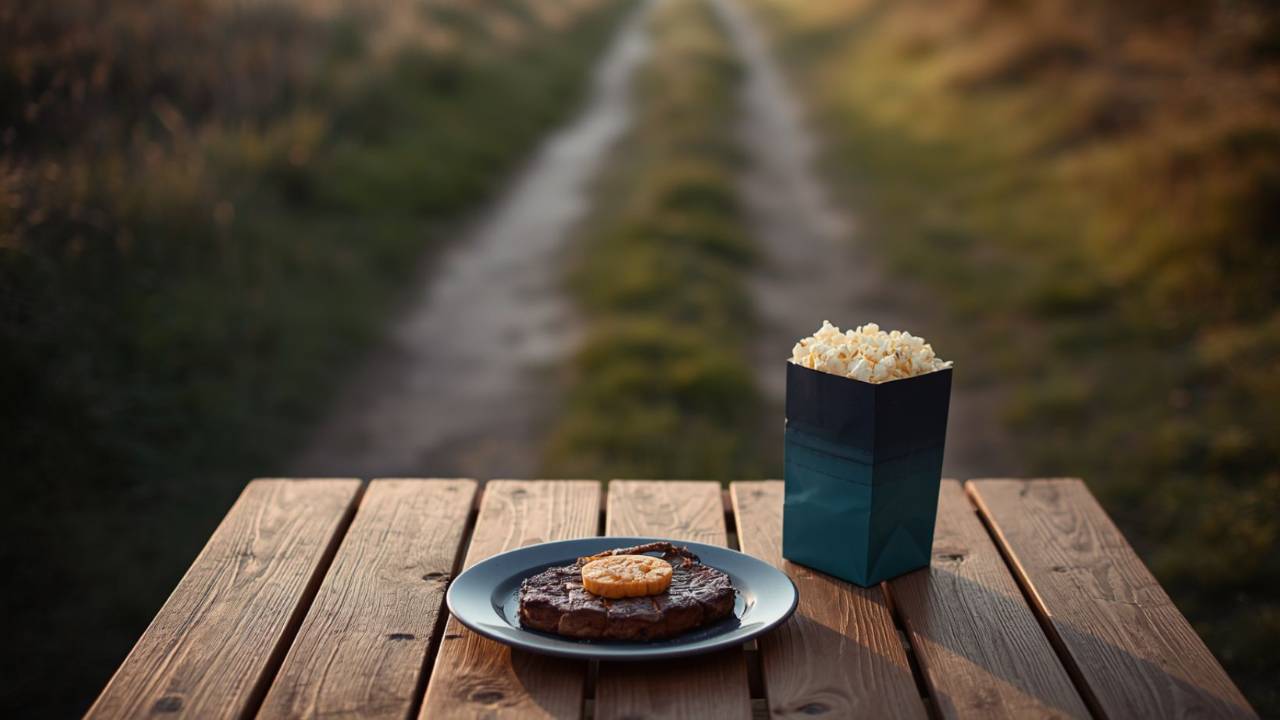
Recently I was talking to a client about how our brains sometimes crave the familiar because the unknown is scarier. Our brains are not wired to evaluate what's good for us. They're wired to evaluate what's familiar and scan for threat.
Familiar reads as safe, even when familiar is actually the thing hurting us. The unknown reads as dangerous, even when it's just untested — not yet proven safe, which is not the same as unsafe.
My client is navigating ending a relationship with somebody who deeply betrayed her. While moving on might be the best thing for her sanity, for a moment, the cling-to-the-familiar part of her brain feared losing the man who cooks steak just the way she likes it. Her brain served up the fear: What if I never eat a good steak again? Not "is this relationship right for me." Not "am I safe, happy, respected." Just — the meal. The very specific, very familiar meal.
So that night, she made the brave decision to cook her own steak. And guess what? It was better than it had ever been.
Our conversation reminded me of my own irrational fear of change:
Years ago, before I was a therapist, I worked in advertising. I knew it was time to change paths. It wasn't the field I wanted long-term, it wasn't lighting me up, and I had a whole other career calling my name. And yet I remember this creeping anxiety about leaving. Was I silly to walk away from the free popcorn in the breakroom?
To be clear — I rarely ate this popcorn. But something about knowing it was available to me made walking away feel like a loss. When I finally did leave? I don't think I ever once missed the popcorn.
It sounds silly written out. Obviously, if I missed the popcorn, I could have easily gone to the store to buy some. But it's such a clear example of how our brains not only cling to what's familiar, but also create fear that blocks our ability to see what we're capable of.
It's so easy to fall into a pattern of familiarity and forget that you're competent enough to find a new, sometimes even better, way. This is the real work in these moments of choice and change: separating what would genuinely be lost from what your brain has simply never had to picture you doing. Separating grief from growth.
If you're standing at the edge of a big decision right now — ending a relationship, leaving a job, becoming a mother and grieving the identity that came before, ending a friendship that's run its course — and you notice your brain fixating on something oddly small, or convincing you that you can't, get curious instead of convinced. Ask it: is this actually the thing I'd lose, or is this just the thing I know how to picture? And then ask: is this actually something I can't do or live without, or just something I've never had to embrace?
Because most of the time, when we finally let go of the familiar and step toward the unknown, we discover something better waiting on the other side. We find room to grow. We find out we can make the meal ourselves. And that the popcorn is only a grocery store run away.
